

Thank you for Subscribing to Gov Business Review Weekly Brief
Gov Business Review: Specials Magazine
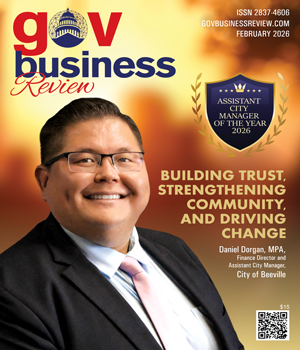
Daniel Dorgan brings proficiency in public sector management, budgeting, and strategic planning across state and municipal environments. His background includes government finance, crossdepartmental coordination, and policy implementation. Dorgan has supported initiatives focused on operational efficiency, infrastructure planning, public service delivery, and collaborative governance to strengthen communities and organizational performance. His work reflects a focus on measurable outcomes, collaborative leadership, and long-term institutional strength. A Journey Rooted in Service When I reflect on my career, I can trace the path I have taken, filled with valuable lessons, unexpected challenges, and an enduring drive to serve my community. Today, I serve as the Assistant City Manager for the City of Beeville, a role I have held since May 2024. However, my journey did not start here, and it has not followed a straight line. Every step, from my academic foundation to my time at various government agencies, has led me to this position, where I manage day-to-day operations and collaborate on long-term strategic planning for the city’s future. My story begins at the University of Illinois at Springfield, where I earned my master’s degree in Public Administration. With my degree in hand, I started my career at the Illinois Governor’s Office of Management and Budget, gaining critical experience in policy analysis and budget management. After a year, I moved on to the City of Oklahoma City, where I served as a Senior Management and Budget Analyst for five and a half years. There, I worked on budgets for a variety of departments, including utilities, public works, parks and general services, municipal court, the city manager’s office, development services, human resources, the municipal counselor’s office, the planning department, and parking and transportation. This experience gave me a broad understanding of how local government operates.
CXO INSIGHTS

Becoming Car Optional: Transforming Transportation Choices
Hanna Cockburn, AICP, Director of Transportation, City of Greensboro

Pinellas Park's Civic Blueprint for Teen Empowerment
Jillian Rose, Community Engagement Program Manager, City of Pinellas Park

Shaping Workforce Strategy with Modern Systems
Sarah Hoover, Director of Human Resources and Recruitment, Commonwealth of Massachusetts

The Unabridged Legacy of a Public Servant Leader
Dr. Marc-Antonie Cooper, Assistant City Manager, City of South Fulton

Strategy and Trust In Modern County Governance
Dr. Kevin Catlin, County Administrator & Controller, Kalamazoo County Government

Transforming Miramar through Smarter Operations And People-Centered Governance
Shaun D. Gayle, ICMA-CM, Assistant City Manager, the City of Miramar, Florida

From Emergency Services to CIO: Leading Through Innovation
Art Thompson, Chief Information Officer, City of Detroit

Embracing Technology in the Government Sector
Kevin Gilbertson, Chief Information Officer, State of Montana

Local Government's Future Fueled by Technology
Nathaniel Wentland, CIO, Loudoun County Government


IN FOCUS

Redefining Urban Governance: The Community-Focused Role of City Assistant Managers
City assistant managers adapt through data-driven governance, community engagement, and operational leadership to support resilient, transparent, and efficient urban administration.

Empowering Citizens: How E-Governance is Redefining Public Interaction
E-governance boosts transparency, efficiency, and citizen engagement through advanced technologies while overcoming digital divides, cybersecurity risks, and legacy system challenges.
EDITORIAL
Operational Leadership Driving Accountable Government
This issue of Government Business Review examines how public sector organizations are strengthening execution capacity as fiscal pressure, regulatory complexity, and public scrutiny intensify. Across the edition, one theme stands out. Sustainable government performance is not driven by vision statements alone. It depends on disciplined administration, coordinated systems, and leadership anchored in public trust.
Our cover story spotlights City of Beeville, where Daniel Dorgan, honored with Top Assistant City Manager 2026, demonstrates what modern municipal management looks like in practice. The role today demands more than oversight. It requires translating policy into outcomes with operational rigor and long range planning working in tandem. In Beeville, that approach is visible through structured strategic planning, cross departmental alignment, and decisive action on critical infrastructure priorities, including water security and utility modernization. The recognition highlights a simple truth. Effective assistant city management is measured not by intent, but by consistent service delivery and measurable community impact.
Beyond the cover story, this edition surfaces leadership perspectives that show how operational discipline sustains public trust at scale. At Fulton County Government, Public Affairs Manager, Jim Gaines positions media relations as a core governance function rather than a reactive task. Drawing on experience in both journalism and public service, he treats responsiveness, clarity, and respect for the public interest as daily operating standards. His approach reframes communication as infrastructure, essential to credibility, stability, and institutional resilience.
Complementing this, Tanya Ange, County Administrator at Washington County, examines the realities of governing amid persistent fiscal and structural constraints. Her insights center on aligning diverse departments around shared priorities, reducing silos, and embedding trust through systems rather than individual leadership. Washington County’s emphasis on coordinated service delivery and internal modernization reflects a deliberate approach to sustaining performance over time.
Together, these stories affirm that effective government leadership is defined by execution, coordination, and accountability. We invite readers to engage with the full issue and explore how disciplined administration continues to shape resilient public institutions.
